Written after a few years of riding flat streets in Phoenix, keeping the receipts, and finding that most bike advice assumes hills, long distances, and mild weather.
The word cruiser gets attached to a look: swept-back bars, fat whitewall tires, a wide sprung saddle, sometimes a tank or a rack that came painted to match. Styling is the least useful way to shop, because two bikes with identical silhouettes can ride nothing alike. What actually determines how a cruiser behaves is a short list of measurements and a number on a scale, and both are visible in the spec sheet before you ever throw a leg over the frame. Understanding those two things tells you, with reasonable precision, which of your regular errands the bike will make easy and which ones it will quietly make worse.
Geometry and weight, not paint
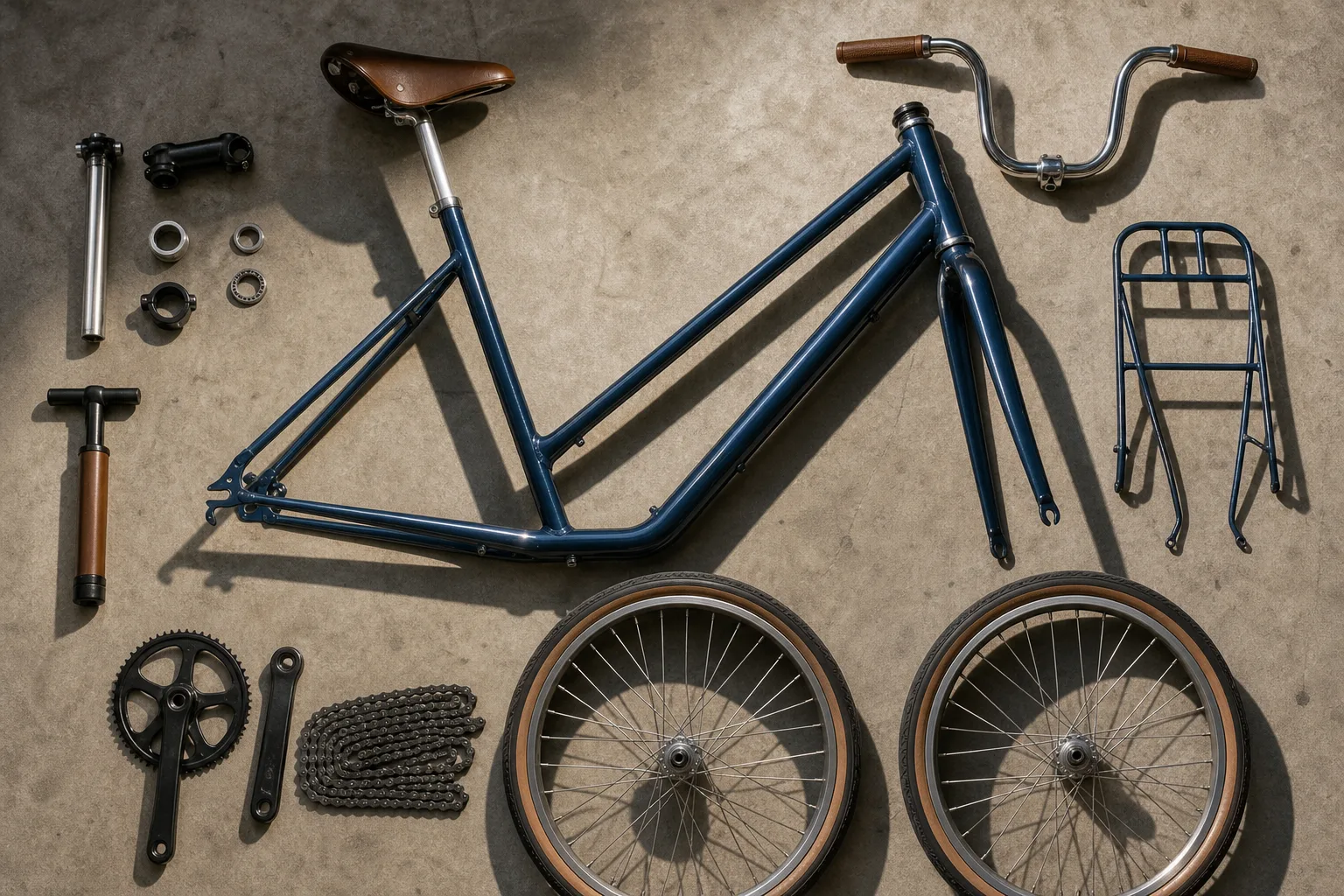
A cruiser puts the rider upright, with the torso close to vertical, the hands near or behind the hips, and most of the body weight resting on the saddle rather than shared with the bars. That comes from a slack seat tube angle, a tall head tube, and handlebars swept back far enough to meet the hands where they naturally fall. The wheelbase is long, the fork rake generous, and the bottom bracket low, which together produce slow, stable steering that resists twitch. Add balloon tires, usually 26 by 2.125 inches, and a steel frame, and the finished bike commonly lands somewhere north of thirty-five pounds. Every one of those choices trades efficiency for comfort.
Weight matters less than people expect on flat ground at steady speed, and much more than they expect everywhere else. A heavy bike takes more work to bring up to speed from a stop, more work to lift onto a bus rack or carry up an apartment stairwell, and more work to hold against a headwind. On a street with no grade and few stop signs, thirty-eight pounds and twenty-four pounds feel nearly identical once you are rolling. On a route with a light every two blocks, the difference is real and it accumulates over the ride.
The trips a cruiser is genuinely good at
The sweet spot is short, flat, and unhurried: roughly a mile to three miles each way, on grades under about two percent, carrying groceries for a night or two rather than a week. That covers a great deal of ordinary life in Phoenix, Tempe, Mesa, and Chandler, where the street grid runs mile to mile and the elevation change across most neighborhoods is measured in single-digit feet. The upright posture keeps your head high in traffic, the wide tires shrug off the gravel and glass that collect at curb cuts, and the low bottom bracket means you can plant a foot at a light without dismounting. For a rider whose week is errands, a coffee shop, and a light rail station, that is most of the job.
Sizing follows the same logic. Step-through frames dominate the category because they let you mount without swinging a leg over cargo, and a well-proportioned women's beach cruiser typically pairs that lower top tube with a shorter reach to the bars so the upright position does not turn into a stretch. What you should check is standover clearance and saddle height, not the frame label. The Consumer Product Safety Commission is responsible for the federal requirements that govern how complete bicycles are built and assembled for sale in the United States, which is a good argument for buying from a shop that assembles what it sells.
Where it turns into work
Four situations reliably expose the design. Distance is the first: past about four miles each way, the upright posture that felt pleasant at mile one starts loading your sit bones and your lower back, because none of your weight is carried by your arms. Headwind is the second, and in the desert it arrives in spring gusts and ahead of monsoon cells, where a vertical torso becomes a sail. Grade is the third: a canal ramp or a freeway overpass is fine, but sustained climbing on a single gear turns into standing on the pedals. The fourth is cargo uphill, which combines the other three.
None of this is a defect. It is what the geometry was chosen to do, and it is why the same rider often ends up wanting a second bike within a year.
What the alternative actually costs
A basic single-speed cruiser sits near the bottom of the adult bike market, which is exactly why it gets bought. A seven-speed hybrid with flat bars, a slightly forward posture, and lighter wheels costs meaningfully more, usually a few hundred dollars more at the same build quality. A three-speed roadster with an internally geared hub sits higher still, because the hub itself is expensive, though it needs almost no maintenance and shifts while stopped, which is worth a great deal at a light on a loaded bike.
The real cost is not the sticker. It is buying the cheap bike, riding it for eight months, discovering your commute is five miles with a real climb, and then buying the correct bike anyway, having spent the first purchase entirely. Used cruisers resell slowly and for little. Deciding honestly, before you buy, what your longest regular trip is and what you carry on it is the cheapest work available to you.
Measure the route you will actually ride most weeks. If it is short, flat, and light, the cruiser is not a compromise but the right tool, and it will still be running in a decade with almost nothing spent on it.